


Can You Renovate a Heritage Listed House in NSW?
Yes, you can renovate a heritage listed house in New South Wales, as long as you follow the necessary approval processes.
General maintenance, minor internal touch-ups or like-for-like works may not require planning approval. But, if you want to make structural modifications, alter the materials and finishes or anything that changes the appearance, you will need council approval, in addition to potentially approval from the NSW Heritage Council.
Is it possible to renovate a heritage listed home in NSW?
Yes, it is possible to renovate a heritage listed home in NSW, but the regulations are strict and navigating them can be complicated.
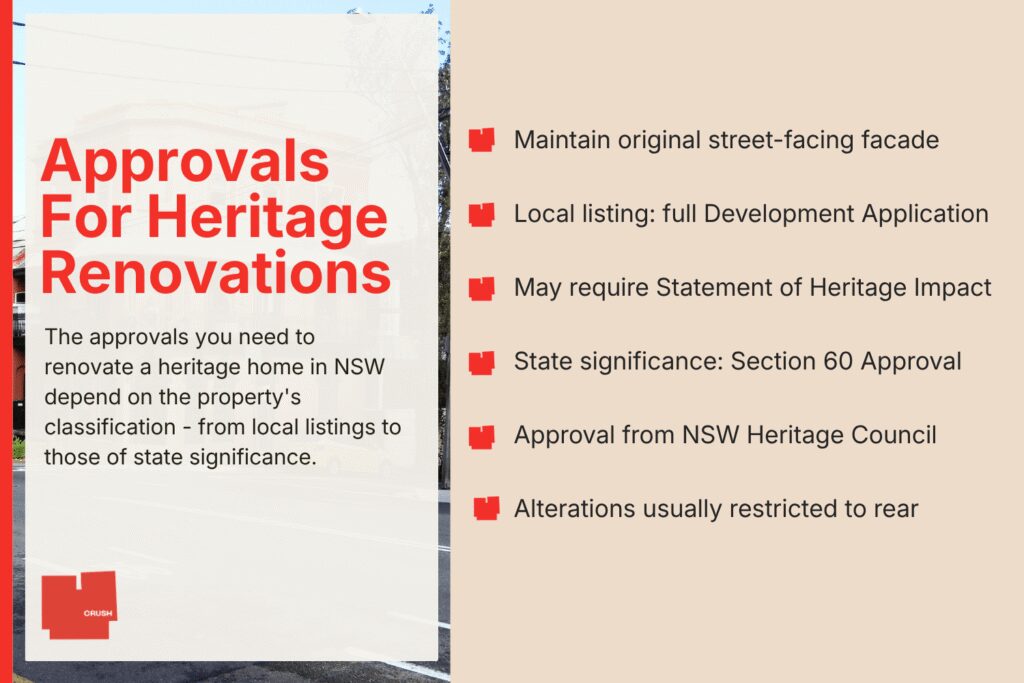
In order to be permitted to renovate a heritage listed house, generally you must maintain the original street-facing facade and historical architectural elements. Additions or alterations to the aesthetic are usually restricted to the rear where they aren’t visible. Also, depending on the property, you may require the services of qualified heritage contractors.
What approvals do you need to renovate a heritage home in NSW?
The approvals you need to renovate a heritage home in NSW depends on the property’s classification:
Local Heritage or Conservation Area
If your property is listed on a Local Heritage Register (LHR) or within a Heritage Conservation Area (HCA), you will need to lodge a full Development Application (DA) with your local council. As part of this submission, you may require a Statement of Heritage Impact (SOHI).
State Heritage Register
If your property is considered of state significance, along with a Development Application (DA) from your local council, you must obtain a Section 60 Approval from the NSW Heritage Council. This will require a Statement of Heritage Impact (SOHI) to be prepared to support your submission.
What renovations are exempt from council approval?
The renovations that are exempt from council approval vary depending on the location of the property and its classification.
Typically, councils will allow you to make like-for-like repairs, conduct minor maintenance, do non-structural interior decorating and even modernise the kitchen and bathrooms (assuming the changes don’t alter internal wall layouts).
Exterior repairs to things like damaged or decaying downpipes or gutters are usually allowed as long as the replacements/repairs match the original materials. This goes for any external maintenance, such as repairs to leaks, broken windows or a boundary fence.
How long does heritage renovation approval take?
The time it takes to get approval to renovate a heritage-listed house varies depending on the extent of the works and the classification of the property.
For minor works it can take as little as 21 to 40 days.
However, if a full Development Application (DA) is required it typically takes 3 to 6 months. For significant works or complicated projects it may take a lot longer as it could require approval from multiple agencies or experts and several rounds of variations to meet council requirements.
If the property is of State Significant (Heritage Council of NSW) you will require a Section 60 works application, which generally has a statutory assessment period of 40 days, or 60 days if the application needs to be advertised. The assessment period pauses if the council asks for more information and restarts once they have received the requests.
Who you need on your team when renovating a heritage listed house
When renovating a heritage listed house you will require a specialised team to meet the council’s requirements.
Local Heritage or Conservation Area
If your property is listed on a Local Heritage Register (LHR) or within a Heritage Conservation Area (HCA), you will need to lodge a full Development Application (DA) with your local council. As part of this submission, you may require a Statement of Heritage Impact (SOHI).
State Heritage Register
If your property is considered of state significance, along with a Development Application (DA) from your local council, you must obtain a Section 60 Approval from the NSW Heritage Council. This will require a Statement of Heritage Impact (SOHI) to be prepared to support your submission.
What renovations are exempt from council approval?
The renovations that are exempt from council approval vary depending on the location of the property and its classification.
Typically, councils will allow you to make like-for-like repairs, conduct minor maintenance, do non-structural interior decorating and even modernise the kitchen and bathrooms (assuming the changes don’t alter internal wall layouts).
Exterior repairs to things like damaged or decaying downpipes or gutters are usually allowed as long as the replacements/repairs match the original materials. This goes for any external maintenance, such as repairs to leaks, broken windows or a boundary fence.
How long does heritage renovation approval take?
The time it takes to get approval to renovate a heritage-listed house varies depending on the extent of the works and the classification of the property.
For minor works it can take as little as 21 to 40 days.
However, if a full Development Application (DA) is required it typically takes 3 to 6 months. For significant works or complicated projects it may take a lot longer as it could require approval from multiple agencies or experts and several rounds of variations to meet council requirements.
If the property is of State Significant (Heritage Council of NSW) you will require a Section 60 works application, which generally has a statutory assessment period of 40 days, or 60 days if the application needs to be advertised. The assessment period pauses if the council asks for more information and restarts once they have received the requests.
[H2] Who you need on your team when renovating a heritage listed house
When renovating a heritage listed house you will require a specialised team to meet the council’s requirements.

1. Heritage Consultant
Start the process by engaging the services of Heritage Consultant as they not only assess the historical significance of the site and prepare a Statement of Heritage Impact (SOHI), but can work alongside your Heritage Architect to determine what impacts their proposed design will have.
2. Heritage Architect or Designer
An experienced Heritage Architect will have knowledge of what typically gets approved or rejected. They can create plans that are sympathetic to both modern living and historical preservation.
3. Heritage Builder/Contractors
Using qualified and experienced contractors to conduct the works is necessary to ensure that traditional techniques and materials are used.
Depending on the scale of the work, additional team members may include a town planner, structural engineer or arborist.
6 common mistakes to avoid when renovating a heritage listed house in NSW
Mistake 1: Assuming a Complying Development Certificate (CDC) applies
Heritage listings and properties within a Heritage Conservation Areas (HCAs) usually don’t qualify for CDCs. Generally, you have to go through the standard Development Application (DA) process or obtain a Heritage Exemption Certificate. However there are exceptions for internal work and a Heritage Architect can identify when those occur.

Mistake 2: Altering the front facade
The street-facing facade is heavily protected by heritage laws. Any alterations or repairs to visible elements of the property will typically need like-for-like materials, and any renovations will be highly regulated.
Mistake 3: Using modern materials
Traditional, older brickwork and the sandstone walls typical of heritage properties in NSW, require soft, breathable binders like lime mortar. Using standard cement will trap moisture, leading to the walls cracking.
Mistake 4: Removing original interior joinery
Demolishing original fireplaces, removing cedar doors, architraves, and ceiling roses is restricted as they define the home’s heritage value.
Mistake 5: DIY or hiring unqualified trades
It’s recommended to engage the services of qualified tradespeople with experience in working on heritage properties. They will know the proper materials and techniques that won’t damage your building’s structural integrity.
Mistake 6: Over-restoring
While restoration of damaged or aged surfaces/structural components is generally permitted, it also comes with occasional caveats. Try not to overdo the restoration such that it reduces the ‘originality’ of the aesthetic. Do the least amount necessary.
Renovating a Heritage Listed property has its challenges and limitations. But as long as you engage the services of an experienced team and go through the appropriate approval processes, it can be highly rewarding.
July 28, 2026
Created to help you clarify what matters most in your heritage home before making decisions that can’t be undone.
A calm guide to understanding your options and how to begin, with care.
Receive the Heritage Home Design Workbook
The Design
Workbook for
Heritage Homes
the free guide
DOWNLOAD HERE