


Federation architecture has a special place in Australian history. Clad in brick and timber, Federation-style homes and buildings can be found across Australia, particularly in inner-city suburbs of Sydney, Melbourne, and Brisbane.
As heritage architects in Sydney who have worked on renovations, extensions, and overhauls for Federation-era homes, we’ve put together this guide to help homeowners understand what’s involved in maintaining and transforming a Federation home.
What is Federation Architecture?
Federation architecture refers to the design approach for homes built between 1890 and 1915, right around the time when the British colonies in Australia formed the Federation of Australia, which later became the Commonwealth of Australia.
During this period, when a core part of national identity was being formed, local architecture was adapting from the traditional architectural design of the United Kingdom to suit the warmer Australian climate. Classic UK housing styles like Queen Anne and Edwardian were integrated with the more suitable outdoor living features like verandahs and timber work.
Because of its European roots, Federation architecture frequently features Baroque architecture, such as cartouches (ornate frames), terracotta roofs with decorative gables, circular (bulls-eye) windows, and intricate detailing in plasterwork. Federation-style, by nature, is immediately recognisable.

Federation Architecture Styles
In the architectural industry, Federation style is an umbrella term used when referring to buildings that mirror the design approaches used during the turn of the 20th century.
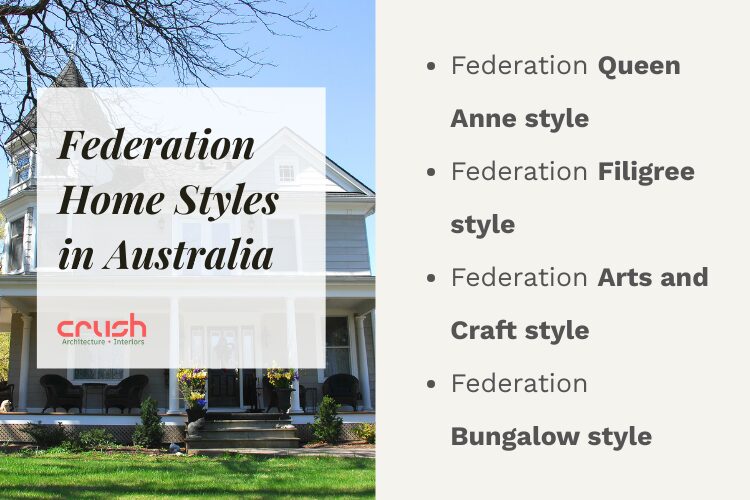
There are a total of 12 Federation styles that originated during this period, with four of the styles commonly used in residential architecture.
Federation Queen Anne style
The Queen Anne style is distinctive for its use of asymmetric gables, front verandahs with timber fretwork, and deep red brickwork. Examples of the Federation Queen Anne style homes in Sydney include the Amesbury in Ashfield and the Hartford in Glebe.
Federation Filigree style
The Filigree style is famous for its “screen” effect, created by intricate decorative work across front verandahs. While common in hotter climates like Queensland, Sydney has many grand examples that use these deep balconies to capture sea breezes. It often retains Victorian-era cast-iron lace or features the newer, “chunkier” Federation timber fretwork.
Federation Arts and Craft style
This style moved away from the trend of mass-produced decorations due to the Industrial Revolution, favouring tailored craftsmanship instead. Featuring high-pitched roofs, roughcast (pebbledash) walls, and tall, tapered chimneys, Federation Arts and Craft style homes are more eclectic than their counterparts.
Federation Bungalow style
The Federation Bungalow was a transition toward the simpler, “modern” living of the 20th century (such as the California Bungalow style). Such homes were built lower to the ground than the Queen Anne style and featured less ornamentation.
Heritage Architecture for Federation Homes
Federation-era homes can easily be over 120 years old – and while some parts of the home may be updated with modern conveniences, most architectural features like verandahs and ornamentation will be original.
For homeowners, the challenge of maintaining the heritage value of a federation-style home can seem daunting, especially considering the strict heritage regulations imposed by state governments and local councils.
Heritage Rules for Homes
Approval pathways for building or construction work depend on the heritage level of the building. While many projects require a Development Application (DA), there are cases, not uncommon, where certain internal works that do not affect the exterior appearance may be approved through a Complying Development Certificate (CDC).
However, most professionals default to the DA process when working with heritage properties, often due to limited familiarity with what can legitimately proceed under a CDC. Through our experience, we understand these nuances and know which consultants and Private Certifiers are comfortable operating within the CDC framework. This can help clients save time and cost while preserving the character of the original home.
Homeowners must engage a heritage architect to create a plan that balances heritage significance and new developments. The heritage architect works with a heritage consultant early on in the process to assess the heritage aspects of the building and prepare a Statement of Heritage Impact, which details how the planned work will affect the property’s heritage value.
With the Statement of Heritage Impact, the heritage architect can submit a Development Application to the local council to get approval for the project.
This is a simplified breakdown of the process – there are many other considerations that apply depending on how you want to modify the property.
Work With Crush Architecture for Federation Homes
If you own a Federation-style home, you have the privilege of protecting and maintaining its heritage significance for future generations. Whether the home is in need of restorative architecture, a renovation to improve its existing layout, or an extension that meets modern living needs, we can help.
Our heritage architects are adept at developing creative solutions that strike the right balance between client needs and heritage guidelines. Get in touch with our team to find out how we can help.
February 24, 2026
Created to help you clarify what matters most in your heritage home before making decisions that can’t be undone.
A calm guide to understanding your options and how to begin, with care.
Receive the Heritage Home Design Workbook
The Design
Workbook for
Heritage Homes
the free guide
DOWNLOAD HERE