


Building or renovating a home is an exciting yet daunting experience. Home constructions come with time dedication, decision fatigue, and a considerable cost for the owner. However, securing the right home construction contract can significantly lower these stresses.
Home construction contracts outline the agreed-upon terms and conditions between the homeowner and the builder of the project. Building contracts will encompass payment schedule, scope of work, construction timeline, who is responsible for obtaining the necessary building permits, how disputes or project issues are handled, and the overall costs involved.
There are different home construction contracts, each designed to suit various scenarios, projects, and preferences. The six most common types of home construction contracts include:
- Lump sum contracts
- Design-build contracts
- Time and materials (T&M) contracts
- Cost-plus contracts
- Unit price contracts
- Guaranteed maximum price (GMP) contracts
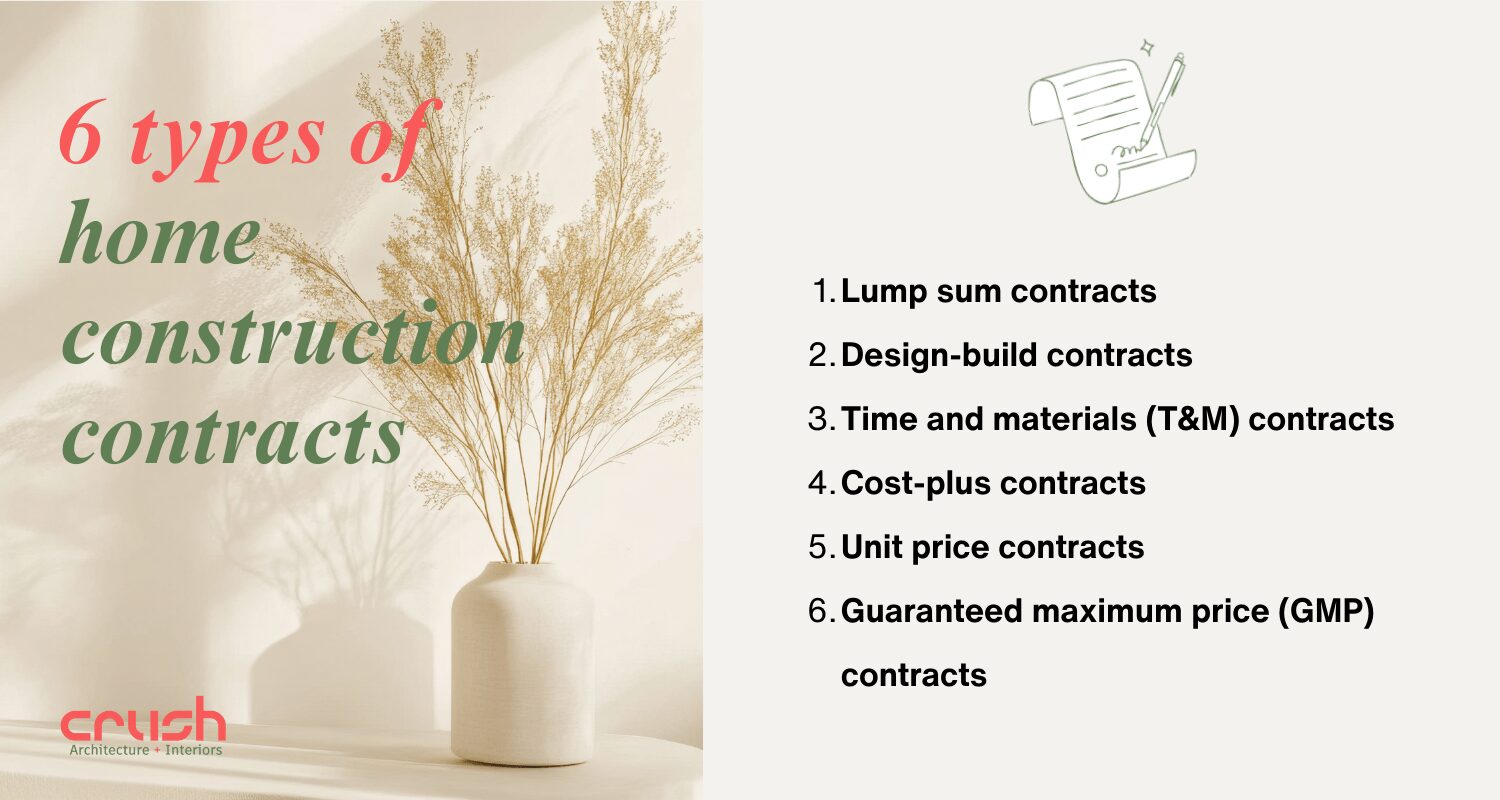
The 6 types of home construction contracts explained
Lump sum
Lump sum contracts include a fixed price for all the materials and labour required during the project. Lump sum contracts under ABIC, with the architect serving as the contract administrator instead of the builder or a project manager, are ideal.
In Sydney, project managers are typically paid directly by the builder. This may pose a conflict of interest, as the homeowner employs project managers but is often paid by the builder to oversee their work. Project managers often also take a commission, ranging from 10% to 20%, from any contractors and consultants they engage. To absorb these fees, the builder may need to cut back elsewhere, compromising the overall quality of the build. Architects, in fact, are obliged by their strict code of conduct to disclose any commissions from contracts; project managers do not need to disclose any type of commission.
ABIC agreements are typically more detailed than other contracts, and are a joint initiative between the Australian Institute of Architects (AIA) and Master Builders Australia. Under ABIC with the architect as contract administrator, lump sum contracts can protect the client’s budget, interests, and vision. This approach provides cost certainty, independent oversight, design integrity, and quality assurance. Lump sum contracts under ABIC are particularly beneficial for heritage and high-performance homes to avoid compromising the project value and their energy efficiency.
Design-build
Design-build contracts are single contracts that address both the architectural design services and the physical construction of the build. This can help streamline the collaboration, communication, and coordination process. However, design-build contracts can be risky. When an owner enters into a design-build contract, the builder controls the design, which can create a conflict of interest, hinder transparency around costs, and compromise on the initial architectural vision.
Time and materials (T&M)
Time and materials (T&M) contracts reimburse contractors for materials used and hours billed on a project, and include a negotiated markup. The hours billed can be charged as an hourly or daily rate. Contractors are generally more favourable towards T&M contracts, as they know their costs will be compensated. Owners receive regular updates as the cost of the work changes, enabling them to monitor the project’s budget and progress. A T&M contract is typically used for projects with uncertain scope and duration.
Cost-plus
Cost-plus contracts cover reimbursement for contractors’ construction costs, as well as a fixed fee or a percentage of the total project cost. A cost-plus contract is designed to allow contractors to be reimbursed for both direct costs (labour, materials, and equipment) and indirect costs (insurance, office space, software subscriptions, and other overhead required to keep the construction business running). There is also an ABIC version of cost-plus contracts, where the architect administers the contract. All cost-plus contracts are often used in construction, particularly when budgets are restricted or estimates are difficult to determine.
Unit price
Unit price contracts divide work into fixed cost units, which are billed separately. This means that rather than billing for labour hours and/or materials, contractors can bill for each unit – making it easier to track progress tracking work progress in the process. Unit pricing, however, can make the overall cost unclear for the owner. Owners must have a rough understanding of how many units are likely to be billed. Unit price contracts are generally utilised in projects where it is unclear how many units of work will be needed.
Guaranteed maximum price (GMP)
A guaranteed maximum price (GMP) contract sets a price cap for a project. This price cap includes project costs (labour, materials, equipment), contractor markup (to cover overhead and the contractor’s profit), contingencies (to account for unforeseen changes), and allowances (for unknown costs related to materials, labour, and equipment). A GMP contract ensures the owner does not pay more than the maximum price agreed upon with the contractor. If the contractor exceeds the maximum price, they are obliged to cover the additional costs. GMP contracts are typically used on larger projects where a well-defined scope and known challenges exist.
While these are the most common types of home construction contracts – it is not an exhaustive list. For more information and guidance around home construction contracts, it’s important to speak to your architect, your builder, and understand the contract and terms that are going to be most suitable to your build.
Crush Architecture is Sydney’s leading architecture and interior design firm, creating visually beautiful and practically functional residential, commercial, and public spaces. We handle the design stage to the construction phase, and everything in between, including securing the right home construction contract for our clients.
September 16, 2025
Created to help you clarify what matters most in your heritage home before making decisions that can’t be undone.
A calm guide to understanding your options and how to begin, with care.
Receive the Heritage Home Design Workbook
The Design
Workbook for
Heritage Homes
the free guide
DOWNLOAD HERE