


As of 13 May 2024, the NSW Government has rolled out new planning controls for new housing under the Transport Oriented Development (TOD) planning reforms.
The TOD planning reforms aim to fast track new housing developments around public transport hubs, creating liveable and vibrant spaces with increased housing. For developers, land owners and investors, the TOD planning reforms will impact future projects including what can be built and how quickly projects can be approved.
What is Transport Oriented Development (TOD) Planning?
Transport Oriented Development (TOD) refers to medium to high density, mixed use development within 400m of major public transport such as train stations, metro stations, or key bus interchanges.
New housing and development in these areas will be assessed under the 2024 state planning controls which provide more flexibility in land use, development types, building heights and density.
As of November 2025, the new planning controls apply to 37 stations across local government areas, with more sites planned in future across Sydney, the Central Coast, Newcastle, and the Hunter Valley. The TOD planning reforms are expected to deliver more than 170,000 new homes in mid-rise dwellings and mixed-use developments over the next 15 years.
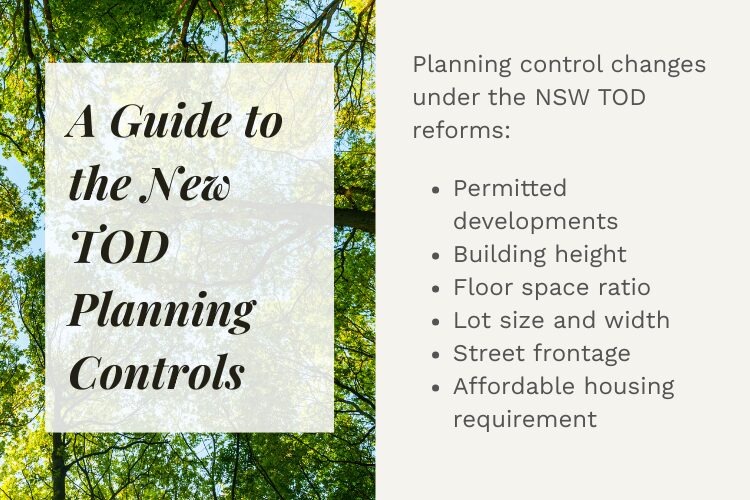
A Guide to the New TOD Planning Controls
NSW TOD planning reforms are being implemented through an amendment to the State Environmental Planning Policy (Housing SEPP), which means the new TOD planning controls will apply over the existing local council Local Environmental Plan (LEP).
Planning control changes under the NSW TOD reforms:
- Permitted developments: Residential flat buildings are now permitted in residential zones and local centre zones. Shop-top housing is also permitted in the local centre and commercial zones within the TOD precinct.
- Building height: Residential flat buildings can be built to a maximum height of 22m, and shop-top housing to a maximum height of 24m.
- Floor space ratio: Buildings in a TOD precinct can have a maximum Floor Space Ratio of 2.5:1 which includes landscaping, building setbacks, privacy, and open space.
- Lot size and width: Minimum lot size requirements have been removed, but lots must still have a minimum width of 21m.
- Street frontage: Developments in local centre zones are required to have active street frontages at ground level, such as cafes or shops.
- Affordable housing requirement: A mandatory 2% affordable housing contribution will apply to Transport Oriented Development projects with a minimum Gross Floor Area of 2,000 m2.
Do TOD Controls Apply to Heritage Properties and Conservation Areas?
Heritage buildings in heritage conservation areas are mostly unaffected by the new TOD planning controls and will still be assessed by the local council to ensure new developments improve or preserve the heritage value of the location.
As a general rule, if heritage law applies to a property, it must always be adhered to. In heritage conservation areas or adjacent areas, the TOD planning controls will only apply to development that does not impact heritage value. This ensures a careful balance between heritage value and new developments.
| Site type | Does TOD apply? | What uplift is possible? | Key constraints |
| Heritage-listed item (local or state) | Very limited – often only sensitive additions or adaptive reuse | Maintain significance, no demolition, scale must be subordinate, HIS mandatory | |
| Property within a Heritage Conservation Area | Partial uplift possible, but often reduced height & massing | Streetscape character, roof forms, setbacks, rhythm, materials – heritage significance overrides TOD | |
| Non-heritage item adjacent to heritage | Often close to full uplift, depending on streetscape | Must mitigate impacts on adjoining heritage; transitions required | |
| Non-heritage land not near heritage | Often close to full uplift, depending on streetscape | Must mitigate impacts on adjoining heritage; transitions required |
List of TOD Locations in NSW
| Station | Local Government Area (LGA) | Month for Finalisation |
| Adamstown | Newcastle | April 2024 |
| Ashfield | Inner West | January 2025 |
| Banksia | Bayside | July 2024 |
| Belmore | Canterbury-Bankstown | December 2024 |
| Berala | Cumberland | October 2024 |
| Booragul | Lake Macquarie | April 2024 |
| Canterbury | Canterbury-Bankstown | May 2025 |
| Cardiff | Lake Macquarie | April 2024 |
| Cockle Creek | Lake Macquarie | May 2025 |
| Corrimal | Wollongong | April 2024 |
| Croydon | Burwood / Inner West | January 2025 |
| Dapto | Wollongong | July 2024 |
| Dulwich Hill | Inner West | January 2025 |
| Gordon | Ku-ring-gai | April 2024 |
| Gosford | Central Coast | July 2024 |
| Hamilton | Newcastle | April 2024 |
| Killara | Ku-ring-gai | April 2024 |
| Kogarah | Bayside / Georges River | April 2024 |
| Kotara | Newcastle | April 2024 |
| Lakemba | Canterbury-Bankstown | December 2024 |
| Lidcombe | Cumberland | April 2024 |
| Lindfield | Ku-ring-gai | April 2024 |
| Marrickville | Inner West | January 2025 |
| Morisset | Lake Macquarie | April 2024 |
| Newcastle Interchange | Newcastle | April 2024 |
| North Strathfield Metro | Canada Bay | November 2024 |
| North Wollongong | Wollongong | May 2025 |
| Punchbowl | Canterbury-Bankstown | June 2025 |
| Rockdale | Bayside | July 2024 |
| Roseville | Ku-ring-gai | April 2024 |
| St Marys Metro | Penrith | May 2025 |
| Teralba | Lake Macquarie | April 2024 |
| Tuggerah | Central Coast | July 2024 |
| Turrella | Bayside | April 2024 |
| Wiley Park | Canterbury-Bankstown | June 2025 |
| Woy Woy | Central Coast | April 2024 |
| Wyong | Central Coast | April 2024 |
*This list has been updated as of November 2025.
What Do the TOD Legislation Changes Mean for Developers?
The introduction of the TOD planning controls opens up new opportunities for developers, investors and land/property owners in applicable areas. The more flexible TOD planning controls allow for more diverse projects in terms of design and use and overwrites previous restrictions imposed by the local council LEPs. TOD projects can be built taller and at higher density and mixed use is encouraged, not constrained.
The TOD planning reforms also offer an accelerated assessment process for eligible projects that meet the design guidelines. The NSW government has identified several “accelerated precincts” where TOD projects can benefit from a fast track approval process to reduce referral delays for developers. An example of this is the design competition exemption for TOD projects – large developments that usually require a design competition can be assessed immediately if the standardised design codes are met, resulting in reduced upfront costs and faster development approval for developers.
The TOD planning controls ultimately aim to turn urban centres near public transport stations into liveable and walkable communities. Developers should still consider how their proposed design aligns with the intent of the TOD reforms as this will impact approval and the project’s long term success. For instance, the principles in the Apartment Design Guide will still apply to developments in Transport Oriented Development locations to ensure consistency with the site’s overall plan.
| Development scale | Indicative size / site area / GFA (for illustrative purposes) | Key controls & opportunities under the TOD program | What to watch / special requirements |
| Small | e.g., sites < ~2,000 m² or gross floor area (GFA) modest (e.g., < 1,000-2,000 m²) | – Located within 400 m of a mapped TOD station zone.- Permissibility for residential flat buildings in residential zones & shop-top housing in local centre/commercial zones. – Building height up to ~22 m for flat buildings, ~24 m for shop-top housing.- Maximum Floor Space Ratio (FSR) approx 2.5:1. | – The mandatory affordable housing contribution kicks in for sites with a minimum GFA (e.g., 2,000 m²). – Heritage items, Aboriginal objects, or certain zones may be excluded from the TOD controls. |
| Medium | e.g., GFA ~2,000 m² to maybe ~5,000 m² / larger lot width, or 4-6 storey mid-rise | – Same core controls as above apply because the TOD program sets standard controls in the mapped areas. – Opportunity for more dwellings, mid-rise form (6 storeys) due to the FSR and height controls. – Mixed-use potential: residential + commercial/shop-top. | – Increased obligations: e.g., mandatory 2 % affordable housing contribution for developments with a minimum GFA of ~2,000 m². – Design quality becomes increasingly important (e.g., reference to the Apartment Design Guide remains applicable). |
| Large / Strategic | e.g., sites > 5,000 m², or major precincts/accelerated precincts (state-led) | – Potentially part of an “accelerated precinct” under TOD program, allowing even larger scale change. – Higher densities, more homes, stronger mix of uses (reflecting the Government’s target to deliver 170,000+ new homes in mid-rise in TOD locations over 15 years). | – State significant considerations may apply (infrastructure, masterplanning, precinct-scale rezoning). – Compliance with affordable housing, heritage, infrastructure demands, design excellence, transition of built form. – Some councils may have alternative schemes replacing the TOD program (e.g., Ku‐ring‐gai Council case). |
Crush Architecture is a Sydney-based architectural firm – we work with developers, commercial builders, and local councils to create sustainable housing and developments that deliver long-term value. If you are building in a TOD precinct, we can advise you on how the new planning controls may apply to your project. The Crush team offers end-to-end architectural services and project management to ensure its success.
December 11, 2025
Created to help you clarify what matters most in your heritage home before making decisions that can’t be undone.
A calm guide to understanding your options and how to begin, with care.
Receive the Heritage Home Design Workbook
The Design
Workbook for
Heritage Homes
the free guide
DOWNLOAD HERE